Forex Education Hub Learning Hub

Search across Beginner, Intermediate, and Advanced forex lessons.

Reading progress 0% · Page 1 of 18
UNIT 1: Forex Foundations
Estimated reading time: 13 minutes
Scroll down to start reading this lesson.
Advertisement
Ad Space

UNIT 1: Forex Foundations

The Forex Market

The forex market is the global market where people, banks, companies and traders buy and sell currencies.

Forex simply means foreign exchange.

Example:
When someone in Kenya changes Kenyan Shillings into US dollars to import a phone from abroad, they are taking part in forex.

What Is Forex Trading?

Forex trading is the buying and selling of currencies  to make profit from changes  in their exchange rates.
Example: Buying USD when it is cheap and selling it when it becomes stronger, the difference in buying price and selling price determines the profit amount.

What Is a Currency?

A currency is the money used in a country.
Examples:
- Kenya uses Kenyan Shilling -KES
- USA uses US Dollar - USD
- Europe uses Euro - EUR
- Britain uses Pound - GBP
- Japan uses Yen - JPY

In forex, curencies are traded in pairs, like:

EUR/USD also written as EURUSD
This means you are comparing the Euro against the US Dolar. (i.e how many USD do you need to purchase 1 EUR).
Page 1 of 18
Advertisement
Ad Space

Exchange Rates

An exchange rate tells you how much one currency is worth compared to another.

Example:
If 1 USD = 130 KES, it means you need 130 Kenyan shillings to buy 1 US dollar.

so if you need to buy something worth $10, you would need:

10 x 130 = 1,300 KES

Exchange rates keep changing every day.

Why Currencies Move

Currencies move because their value depends on supply and demand.

A currency can become stronger or weaker because of things like:

1. Interest rates
If a country gives higher interest rates, investors may want that currency more, making the currency much stonger.

2. Inflation
If prices in a country rise too much, its currency may lose value.(inflation example: a dollar currently buys less bread than last year)

3. Economy strenth
A strong economy usually supports a strong currency.

4. Politics and stability
If a country has political problems, investors may avoid its currency.

5. Imports and exports
If kenya imports more than it exports, more dollars may be needed, which can weaken the shilling.

In simple words: Currencies move because people are constantly buying and selling them based on need, confidence, and economics conditions.


Page 2 of 18
Advertisement
Ad Space

Why People Trade Forex

People trade forex for different reasons, some trade to make profit, while other trade to protect themselves from currency changes.

1. To Make Profit
Most traders buy an sell currecies hoping to profit when prices move.
Example:
A trader buys EUR/USD because they believe the Euro will become stronger than the dollar.

2. Speculation
Speculation means predicting where the market may go next.
Example:
If a trader believes the US Dollar will rise after good news from the US economy, they may buy USD.

3. Hedging
Businesses use forex to protect themselves from exchange rate risk.
Example:
A kenyan importer may buy dollars early before the dollar becomes more expensive.

4. High Liquidity
Forex has many buyers and sellers, so traders can enter and exit trades easily.

5. Easy Accessibility
Forex can be traded online using a phone, laptop, or a computer, making it accessible to many people.

6. The Risk Side
Forex can bring profit, but it can also cause losses. Prices can move fast, so traders must use proper risk management.

In simple words:
People trade forex to make money from currency movements, but they must understand the risks before trading.

Page 3 of 18
Advertisement
Ad Space

How the forex Market Works

The forex market works by buying one currency and selling another currency at the same time.

Forex is an OTC market, meaning it does not have one central physical exchange like the stock market. Instead, trading happens electronically through banks, brokers, and financial instituitions around the world.

Main Players in the Forex Market

Banks
Big banks trade large amounts of money and help provide market prices.

Brokers
Brokers connect retail traders to the forex market through trading platforms like MetaTrader.

Liquidity Providers
These are large instituitions that make sure there is enough buying and selling activity in the market.

Buyers and Sellers
every trade needs a buyer and a seller. One trader may be buying EUR/USD while another is selling it.

Price Quotes
Forex prices are shown in currency pairs.
Example: EUR/USD = 1.1000 means 1 euro is worth 1.1000 US Dollars. 
If price moves up, the Euro is becoming stronger against the dollar, if price moves down, The Euro is becoming weaker against the Dollar.

Simple Example
If a trader believed EUR will rise, they buy EUR/USD. if price goes up, they can close the trade and make profit. if the price goes down, they may lose money.

Conclusion
The forex market works by connecting buyers and sellers through brokers and banks, where currencies are traded based on the changing prices

Page 4 of 18
Advertisement
Ad Space

Forex Market Participants

The forex market is made up of different groups that buy and sell currencies for different reasons.

1. Central Banks

Centra banks control a country's money supply and interest rates.

Example
The Central Bank of Kenya may take action to support the kenyan shilling. 

2. Commercial Banks

Big banks trade large amounts of currencies every day for clients and themselves.

3. Funds and Institutions

Investment funds and financial institutions trade forex to make profit or manage money.

4. Companies

Companies exchange currencies when buying or selling goods internationally.

Example:
A Kenyan importer may buy USD to pay suppliers in dubai or china.

5. Brokers

Brokers connect retail traders to the forex market through trading platforms like MetaTrader.

6. Retail Traders

These are individuals who trade forex using phones, laptops, or computers.
Example: A beginner trader buying EUR/USD through broker.

7. Liquidity providers

These are large banks or institutions that help ensure there are enough buyers and sellers in the market.

in simple words:
Forex participants are the people and institutuins that buy and sell currencies, causing price to move in the market.

Page 5 of 18
Advertisement
Ad Space

Currency Pairs Explained

In forex, currencies are traded in pairs bacause you are buying one currency while selling another.

Example:
EUR/USD

Base Currency

The base currency is the first currency in the pair.

Example
In EUR/USD, EUR is the base currency.

Quote Currency

The quote currency is the second currency in the pair.

Example:
in EUR/USD, USD is the quote currency.

Exchange rate Meaning

The exchange rate shows how much of the quote currency is needed to buy 1 unit of the base currency.

Example:

If EUR/USD = 1.1000, it means:

1 Euro = 1.1000 US Dollars

How to Read Pair Prices

If EUR/USD goes up, the Euro is getting stronger against the Dollar.
If EUR/USD goes down, the Euro is getting weaker against the Dollar.

Simple Example

If USD/KES = 130, it means:

1 US Dollar = 130 Kenyan shillings

So, currency pairs help traders compare the value of one currency against another.

Page 6 of 18
Advertisement
Ad Space

Major, Minor, and Exotic Pairs

Forex pairs are grouped into major, minor, and exotic pairs based on the currencies involved.

1. Major Pairs

Major Pairs include the US Dollar (USD) paired with another currency.

Examples:

EUR/USD, GBP/USD, USD/JPY, USD/CHF, AUD/USD

Major Pairs usually have:

 - High liquidity
 - Lower spreads
 - Smoother price movement
 - More market information available
This is why beginners are advised to start with major pairs.

2. Minor Pairs

Minor pairs do not include the the US Dollar, but they involve strong currencies.

Examples:

EUR/GBP, EUR/JPY, GBP/JPY

Minor pairs can still be good to trade, but they many have wider spreads and stronger movements than majors.

3. Exotic pairs

Exotic pairs include one major currency and one currency from a smaller or developing economy.

Examples:

USD/ZAR, USD/TRY, USD/KES

Exotic pairs usually have:

 - Lower liquidity
 - Wider spreads
 - Higher volatility
 - Bigger risk

Summary
Biginners should start with major pairs because they are easier to understand, cheaper to trade, and usually more stable than minor or exotic pairs. 

Page 7 of 18
Advertisement
Ad Space

Bid, Ask, and Spread

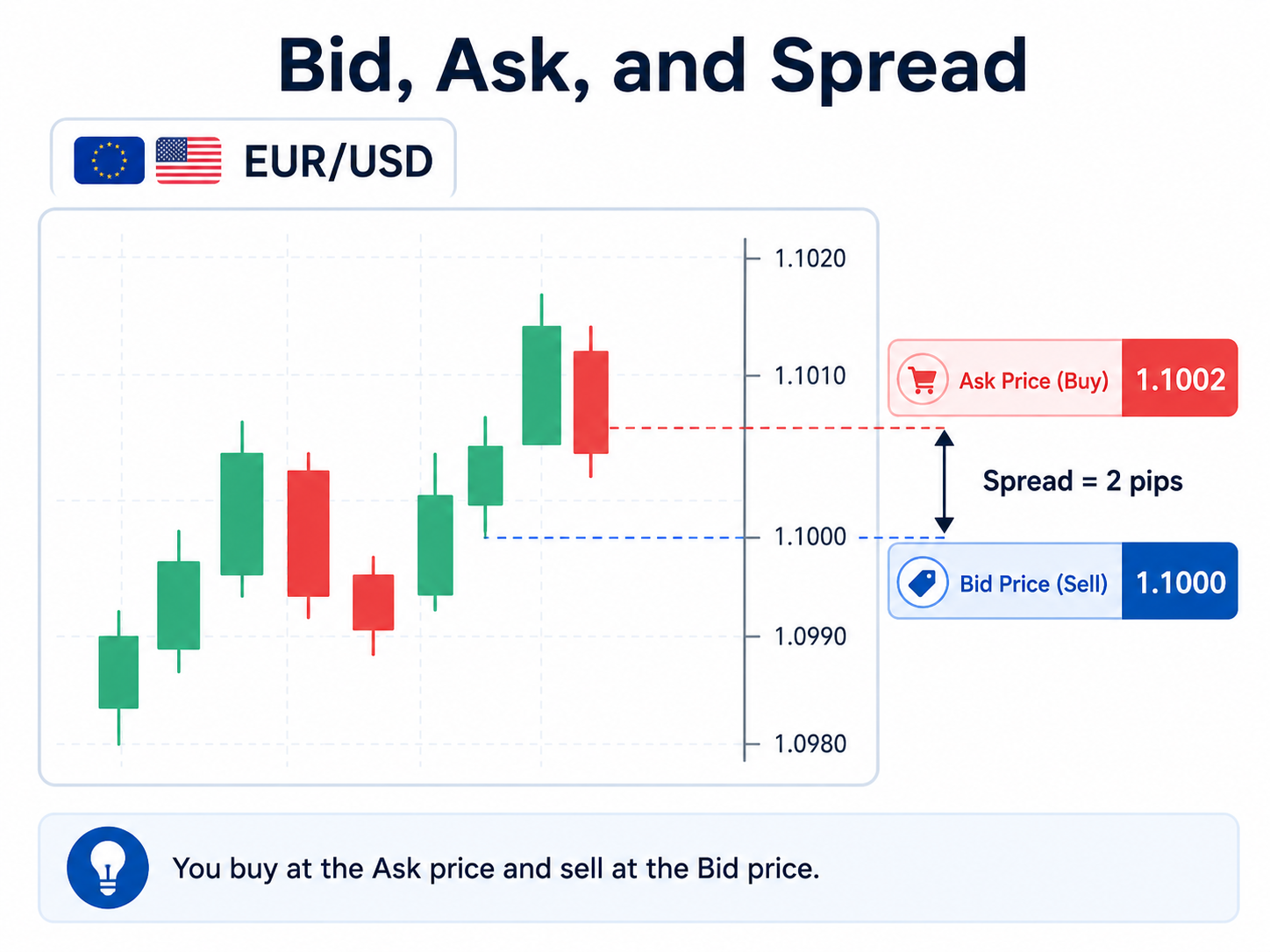
In forex, every currency pair has two prices: the bid price and the ask price.

The bid price is the price where you can sell.

The ask price is where you can buy.

Example:
If EUR/USD shows:

Bid: 1.1000
Ask: 1.1002
Forex lesson illustration
It means you can sell at 1.1000 and buy at 1.1002.

The difference between the bid and ask price is called the spread.

In this example:

1.1002 - 1.1000 = 2 pips spread

The spread is like the broker's small charge for opening a trade.

Spread Widening

Sometimes spreads become bigger, especially during news, market opening, or low trading activity.

Example:
A spread may move from 2 pips to 10 pips, making trading more expensive.

Conclusion:
Bid is the selling price, ask is the selling price, and spread is the cost of entering a trade.

Page 8 of 18
Advertisement
Ad Space

Pips and Pipettes

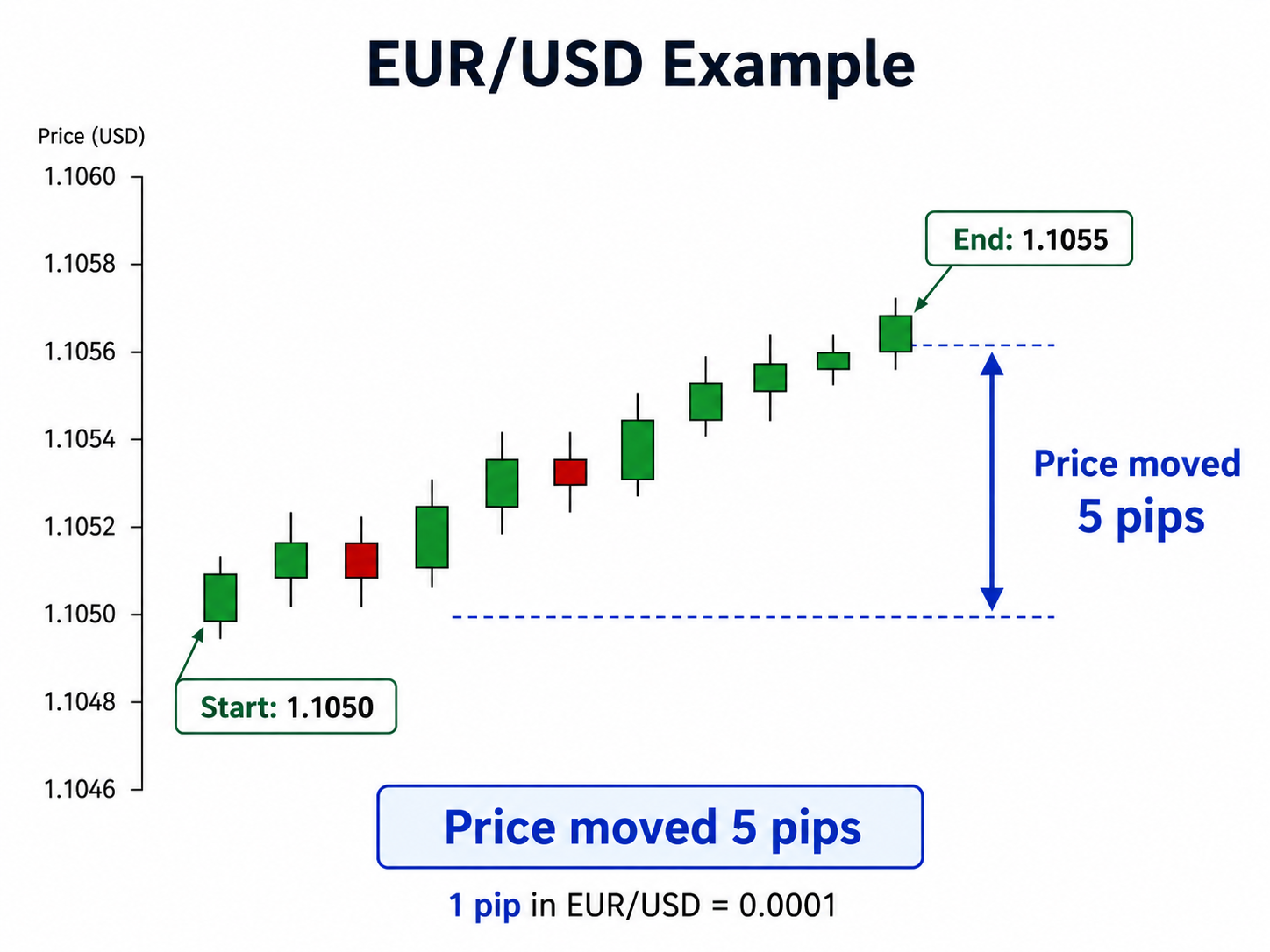
A pip is the standard unit used to measure price movement in forex.

For most currency pairs, 1 pip = 0.0001.

Example:
If EUR/USD moves from 1.1050 to 1.1055, the price has moved 5 pips. 
Forex lesson illustration

Page 9 of 18
Advertisement
Ad Space

A pipette is a smaller measurement, it is one-tenth of a pip.

For most pairs:

1 pipette = 0.00001

Example:
If EUR/USD moves from 1.10500 to 1.10501, that is 1 pipette.

JPY Pairs

Pairs that include the Japanese Yen are measured differently.

For JPY pairs:

1 pip = 0.01
1 pipette = 0.001

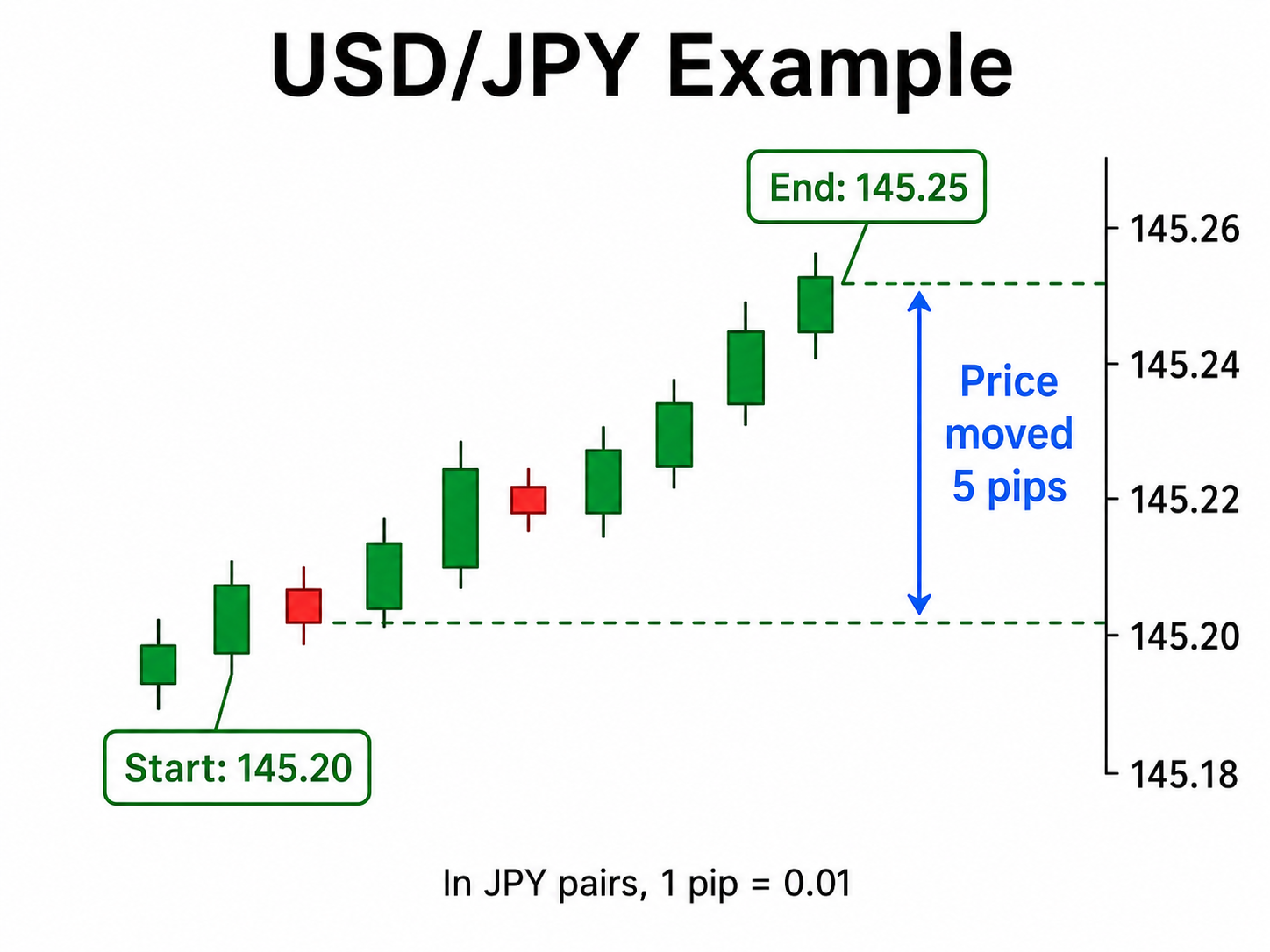
Example:

If USD/JPY moves from 145.20 to 145.25, the price has moved 5 pips.

Forex lesson illustration

Summary

Pips show how far price has moved. pipettes show smaller price changes inside one pip.

Page 10 of 18
Advertisement
Ad Space

Lots and Trade Size

In forex, a lot means the size of the trade you are opening. It shows how many units of a currency you are buying or selling.

Types of Lots

Standard lot = 100,000 units
This is a large trade size and usully risky for small accounts.

Mini lot = 10,000 units
This is smaller than a standard lot.

Micro lot = 1000 units
This is good for beginners because the risk is lower.

Nano lot = 100 units (usually used in cent accounts)
This is very small and is useful for practice or very small accounts.

Why lot Size Matters

lot size matters because it controls how much money you can make or lose when price moves.

Example:
On many USD pairs, a 1 pip move may be approximately:

Standard lot: $10 per pip
Mini lot: $1 per pip
Micro lot: $0.10 per pip
Nano lot: $0.01 per pip

This means the bigger the lot size, the bigger the profit or loss.

Summary

Lot size is the amount you trade. beginners should start with small lot sized because smaller trades reduce risk and help protect the trading account.


Page 11 of 18
Advertisement
Ad Space

Leverage and Margin

Leverage allows a trader to control a bigger trade using a smaller amount of money.

Example:
With 1:100 leverage, a trader can control a $10,000 trade using $100 margin.

Margin Requirement

Margin is the ammount of money your broker sets aside to open and keep a trade running.

Example:
If your trade needs $100 margin, the amount is locked while the trade is open.

Free Margin

Free margin is the money left in your account that can be used to open new trades or support existing trades.

Example:
If your balance is $500 and $100 is used as margin, your free margin is aroud $400, before profit or loss changes.

Margin level

Margin level shows how healthy your account is.

It is calculated as:

Margin level = Equity ÷ Used Margin x 100

A high margin level means your account is safer.
A low margin level means your account is at risk.

Risk Warning

Laverage can increase profits, but it can also increase losses. A small market movement can cause a big loss when using high leverage.

Summary

Leverage gives you more buying power, while margin is the money needed to open a trade. beginners should use low laverage and small lot sizes to protect their account.

Page 12 of 18
Advertisement
Ad Space

Profit and Loss Basics

In forex, traders make or lose money when price moves after they open a trade.

profit or loss depends on three main things:

    1. Direction of the trade

    2. Number of pips price moves

    3. Lot size used

    Buying

    When you buy, you make profit is price goes up.

    Example:
    You buy EUR/USD at 1.1000 and price moves to 1.1050.

    The price has moved 50 pips up so the trade is in profit.

    If the price goes down instead, the trade makes a loss.

    Selling

    When you sell, you make profit is price goes down.

    Example:
    You sell EUR/USD at 1.1000 and price moves to 1.0950.

    The price has moved 50 pips down so the trade is in profit.

    If the price goes up instead, the trade makes a loss.


    Page 13 of 18
    Advertisement
    Ad Space

    Lot Size and Profit

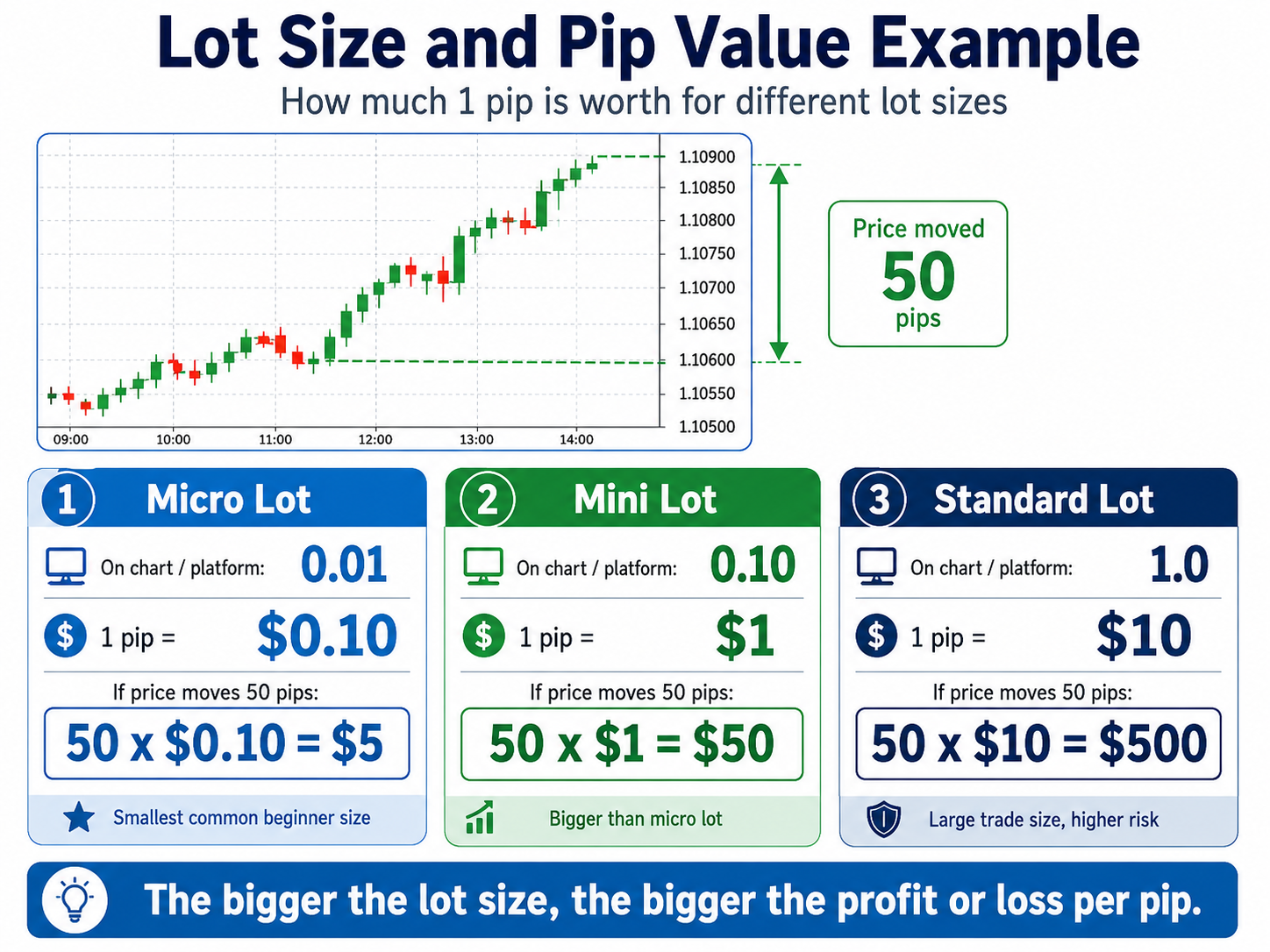
    Lot size decides how much each pip is worth.

    Example on many USD pairs:

    Micro lot: 1 pip = $0.10
    Mini lot: 1 pip = $1
    Standard lot: 1 pip = $10

    So if price moves 50 pips:

    Micro lot will return: 50 x $0.10 = $5
    Mini lot will return: 50 x $1 = $50
    Standard lot will return: 50 x $10 = $500


    On forex charts micro lot is written as 0.01, Mini lot is wriiten as 0.10 and standard lot as 1.0.
    Forex lesson illustration

    Summary

    Traders make money when price moves in their predicted direction. They lose money when price moves against them. The bigger the lot size, the bigger the profit or loss.


    Page 14 of 18
    Advertisement
    Ad Space

    Forex Trading Sessions

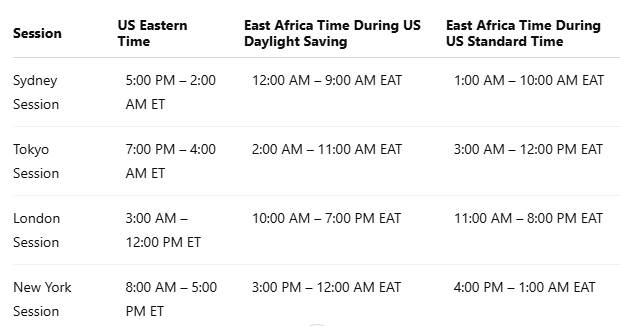
    The forex market is open 24 hours a day, Monday to Friday because diffrent financial centres open at different times around the world.

    The main forex sessions are Sydney, Tokyo, London, and New York.
    Forex lesson illustration


    Sydney Session

    This is the first session to open. Market movement is usually slower, but AUD and NZD pairs may be active.

    Tokyo Sessions

    Also called the Asian session. JPY pairs like USD/JPY and EUR/JPY are often more active during this time.

    London Session

    This is one of the busiest sessions. Many traders like this session because it usually has strong movement and high liquidity.

    Page 15 of 18
    Advertisement
    Ad Space

    New York Session

    This session is also very active, especially for USD pairs like EUR/USD, GBP/USD, and USD/JPY.

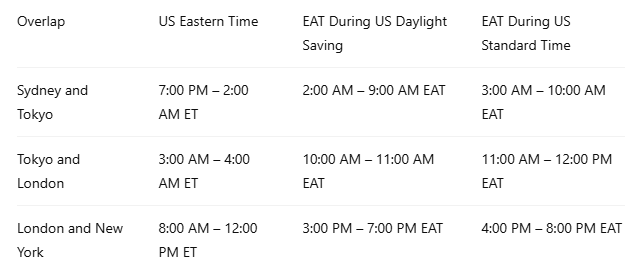
    Session Overlaps

    The market becomes more active when two sessions are open at the same time.
    Forex lesson illustrationThe London and New York overlap is usually the most active because many traders from Europe and America are trading at the same time.

    Daylight Saving Time Note

    US Estern Time changes during the year.

    During Daylight Saving Time, it is called EDT.
    During normal standard time, it is called EST.

    East Africa Time does not change because Kenya and most East African Countries do not use daylight saving time.

    This means the time difference between US Eastern Time and East Africa Time changes: 

    Page 16 of 18
    Advertisement
    Ad Space

    During EDT: EAT is 7 hours ahead of New York.
    During EST: EAT is 8 hours ahead of New York.

    Daylight saving time can shift forex session hours by 1 hour, so traders may see London or new York open earlier or later in their local time.

    Summary

    Forex activity changes depending on which session is open. beginners often focus on the London session or the London-New York overlap because the market usually has better movement, tighter spreads and more trading opportunities.

    NB: In the US, daylight saving time generally runs from the second Sunday in march to the first Sunday in November, while Kenya observes EAT, UTC+3, with no daylight saving changes.

    We have come to the end of this unit 1 (Forex Foundations), as a learner you should now be able to:

      • Explain what the forex market is and how currencies are traded.

      • Define currencies, exchange rates, and currency pairs.

      • Identify the base currency and quote currency in a forex pair.

      • Explain the difference between major, minor, and exotic pairs.

      • Understand bid price, ask price, and spread.

      • Explain what pips and pipettes are and how price movement is measured.

      • Describe standard, mini, micro, and nano lot sizes.

      • Understand how leverage and margin work.

      • Explain how traders make or lose money from price movement.

      • Identify the main forex trading sessions: Sydney, Tokyo, London, and New York.

      • Explain why market activity changes during different sessions and overlaps.

      • Understand how daylight saving time can affect trading session hours.


    Page 17 of 18
    Advertisement
    Ad Space

    END OF UNIT 1 (FOREX FOUNDATIONS)

    This unit is meant to equip you with the basics and terms used in forex trading, it is a must for every trader to understand these basic as they are the core foundation of the market. you are adviced to research more on topics above that you do not undertand and if necessary send a message to the admin for clarification on the contact tab.

    Disclaimer: Forex trading carries a significant amount of risk, approach it with caution and open mind, Forex is not a get rich quick scheme

    Page 18 of 18
    Advertisement
    Ad Space

    Finished this unit?

    Mark it as completed so you can track your learning progress.

    Resumed where you left off